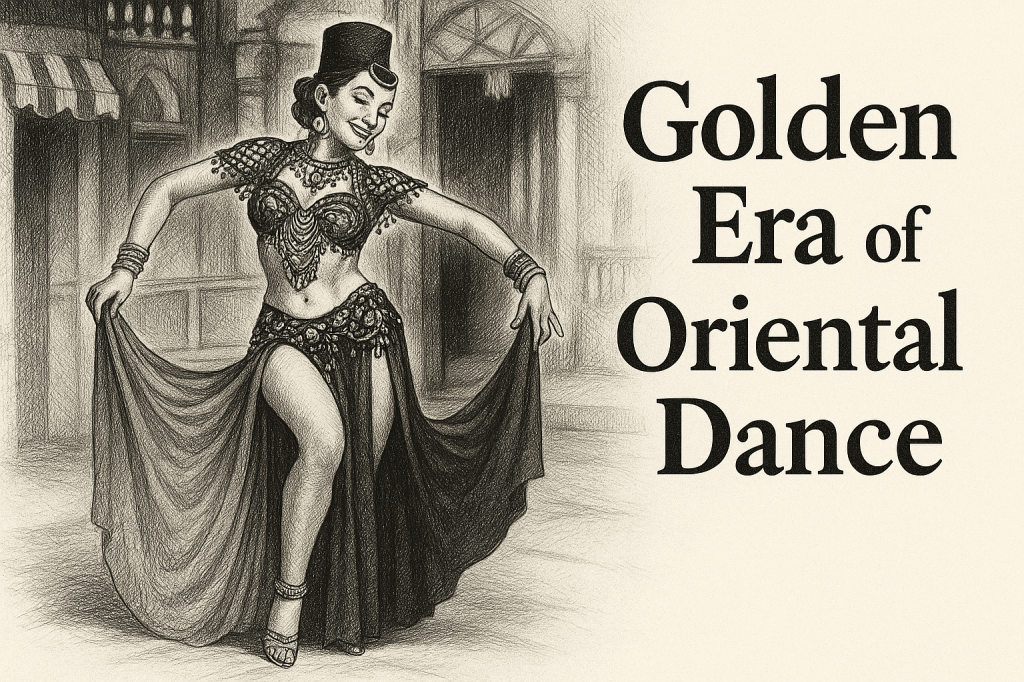
The Magic of the Golden Era
We call it the Golden Era because it was truly the golden age of Egyptian cinema—not only in dance, but also in music, theatre, and film. For Oriental Dance, this period was the pinnacle of artistry: a moment when the dance, after thousands of years of survival and evolution, finally stepped proudly onto the silver screen.
Oriental Dance could have been lost through time. Yet, from the rituals of Ancient Egypt, through centuries of cultural preservation, it endured. And then, in the early 20th century, with the birth of cinema and the rise of modern entertainment, the dance declared:
“Here I am—this is my time to shine.”
It was not just a historical coincidence; it was the culmination of millennia. At that precise moment, dance and cinema grew together, creating an explosion of artistry that would forever define the image of Oriental Dance.
Badia Masabni: The Visionary Force
At the center of this transformation was the remarkable Badia Masabni—not only an entrepreneur, but also a dancer and teacher of Oriental Dance herself. Born in Lebanon, she carried with her a deep understanding of both Eastern and Western artistic traditions.
In Cairo, she opened her famous cabaret Casino Opera, a glamorous venue that became the training ground for a new generation of dancers. There, she didn’t just present shows—she crafted an art form. She combined her own experience as a performer with her sharp eye as a director, and she trained and mentored dancers who would later become international legends.
Her vision was revolutionary: she welcomed collaborations with European and Russian choreographers, blending theatrical staging and balletic elements into Oriental Dance. Yet she always preserved its authenticity and soul. Thanks to her, dancers began to develop individual styles, each one unique and unforgettable.
Among her protégées were the brightest stars of the Golden Era: Samia Gamal, known for her elegance and grace; Taheya Kariokka, famous for her charisma and theatrical power; and many others who marked history with their artistry.
A Cultural Renaissance
The Golden Era was more than glittering shows in Cairo—it was a cultural renaissance. Music blossomed with great composers and orchestras; cinema became a new stage for dance; and Egypt’s art scene drew inspiration from all directions.
Through film, Oriental Dance became immortalized. Audiences around the world saw it on the big screen, and the image of the Oriental dancer became synonymous with elegance, mystery, and beauty. Egyptian stars began to perform internationally, in Europe, Russia, and the United States, spreading their influence and inspiring dancers across continents.
This was a time when Oriental Dance wasn’t just entertainment—it was a symbol of national pride, artistry, and identity.
Why It Matters Today
When we speak of the Golden Era, we speak of a time when Oriental Dance reached its highest artistic expression. Every style, every step, every modern variation we see today can be traced back to this period.
For dancers today, studying the Golden Era means going back to the roots. It means understanding not only the steps, but the artistry, the expression, and the philosophy that defined an entire generation. Too often, students learn techniques without knowing their lineage—without knowing why they exist or where they came from.
By revisiting the Golden Era, we transform ourselves into explorers of history, learning directly from the source that shaped the art we practice today. This is how we, too, can refine our style, deepen our expression, and grow into true professionals.
An Invitation to Study the Golden Era
At the Oriental Dance Academy, we are proud to present a two-session program dedicated to the Golden Era of Oriental Dance. This special course is designed to give dancers both the technical foundation and the artistic experience that defined this magical era.

Part 1: Technique
In this first session, we will focus on the techniques of the Golden Era, both ancient movements that existed before 1900 and the modern refinements developed between 1900 and 1950. You will study arms, arabesques, hips, and foundational techniques that are the “mothers” of today’s movement vocabulary. Many of these are rarely taught now, yet they are essential when dancing Golden Era repertoire.
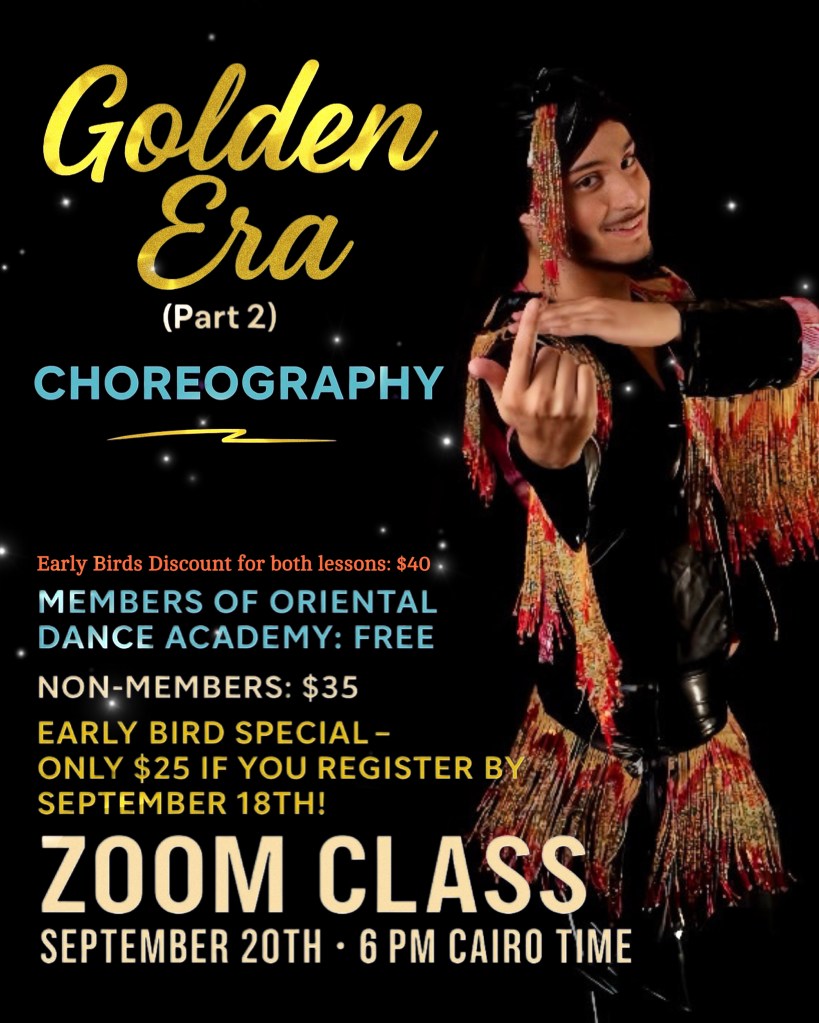
Part 2: Choreography
In the second session, we will bring these techniques to life by creating a full choreography. Set to authentic Golden Era music, this class will guide you through the creative process: how to connect movements, structure a dance, and build a piece with emotion and artistry. You will not only learn a choreography, but also how to create your own works with depth and authenticity.
Together, these two sessions form a complete program—a treasure for dancers who wish to connect with the roots of Oriental Dance while elevating their own style.
Dates & Prices
📍 Session 1: Technique
📅 September 13th • 6 PM Cairo Time
💰 Non-members: $35
⚡ Early Bird: $25 (until September 11th)
📍 Session 2: Choreography
📅 September 20th • 6 PM Cairo Time
💰 Non-members: $35
⚡ Early Bird: $25 (until September 18th)
💡 Special Offer
🔥 Get both sessions for only $40 if you register before September 11th!
🌟 Best Value – Subscribe!
For just $55 per month, you get:
✅ Both Golden Era sessions
✅ Over 100 recorded lessons
✅ All future live classes included
👉 Subscribing is the most cost-effective way to access not only these Golden Era sessions but the entire universe of Oriental Dance.

 Oriental Dance Academy Online
Leave a comment